 Gulte Movie News And Politics
The controversy surrounding former Delhi Chief Minister Arvind Kejriwal’s official residence has returned to the spotlight, with the BJP-led Delhi government opening the property to media personnel on Friday, November 27. The government has also indicated plans to allow members of the public to visit the bungalow, which the BJP has repeatedly referred to as ‘Sheesh Mahal’.
Located at 6, Flagstaff Road in Delhi’s Civil Lines area, the bungalow served as Kejriwal’s official residence during his tenure as Chief Minister. The BJP coined the term ‘Sheesh Mahal’ during its campaign against the Aam Aadmi Party (AAP), accusing Kejriwal of spending excessively on renovating the property despite building his political identity around simplicity and opposition to VIP culture.
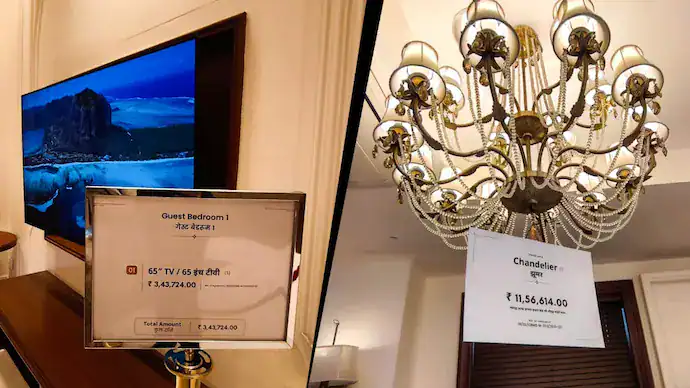
The media walkthrough on Friday offered a glimpse of the interiors and furnishings, with the Delhi government displaying the reported costs of several items installed at the residence.
Among the items highlighted were a chandelier reportedly costing ₹11.56 lakh, a sofa priced at ₹5.47 lakh, chairs worth ₹5.58 lakh, a central table costing ₹6.79 lakh and curtains valued at approximately ₹5.69 lakh. An expenditure board installed outside the property displayed a total spending figure of ₹58,83,66,314, or approximately ₹58.83 crore.
Delhi Public Works Department (PWD) Minister Parvesh Verma said the objective of opening the property was to show people how public money had been spent. The government is also considering a public viewing facility with a proposed entry fee of around ₹20. Senior citizens and college students may reportedly be allowed free entry.
How did the Sheesh Mahal controversy begin?
The controversy dates back to the renovation of the official Chief Minister’s residence. Kejriwal occupied the bungalow from 2015 to 2024, and renovation work was undertaken during his tenure.
The issue became a major political talking point ahead of the February 2025 Delhi Assembly elections. The BJP accused Kejriwal of abandoning his promise of simple living and using taxpayers’ money to create a luxurious residence.
The controversy gained further attention after the Comptroller and Auditor General (CAG) examined the expenditure on the renovation.
What did the CAG report find?
A CAG report tabled in the Delhi Assembly on March 23, 2026, put the expenditure on renovation works at ₹33.66 crore, against an initial estimate of ₹7.91 crore. This represented a cost escalation of approximately 342 per cent. According to the audit, ₹18.88 crore was spent on superior specifications, artistic, antique and ornamental items.
The report also flagged several administrative and procedural issues. The built-up area increased from 1,397 square metres to 1,905 square metres, marking a 36 per cent increase. The PWD revised its preliminary estimates four times to accommodate the additional expenditure.
The audit further pointed out that administrative approval and expenditure sanctions amounting to ₹9.34 crore were granted more than two months after the work had been completed. It also questioned the decision to execute additional works worth ₹25.80 crore through a single contractor without exploring fresh tendering.
The CAG additionally flagged the diversion of funds originally sanctioned for a staff block and camp office. Importantly, the ₹33.66 crore recorded by the CAG and the ₹58.83 crore displayed by the Delhi government on Friday are different expenditure figures. They should not be treated as interchangeable without accounting for the different components covered.
What is AAP’s position?
AAP has rejected the BJP’s allegations, calling the controversy politically motivated. The party has maintained that the property was an official government residence and that the renovation was undertaken to address the building’s condition.
The BJP, meanwhile, has continued to use the bungalow as an example in its criticism of AAP’s claims of political simplicity and clean governance. With the Delhi government now opening the property to media personnel and considering public tours, the Sheesh Mahal controversy has acquired a new dimension.
What began as a political argument over the renovation of a Chief Minister’s residence has now become a debate over public expenditure, government procurement and accountability. The central question remains whether the money spent on the property was justified and whether the procedures followed were consistent with public accountability.
Latest Articles





Tags Sheesh Mahal