 Gulte Movie News And Politics

For decades, America was the ultimate destination for Indian technology professionals. A job in Silicon Valley, an H-1B visa and eventually a green card represented the American Dream. But that equation appears to be changing. An increasing number of Indian professionals are reconsidering their future in the US, even when they have well-paying jobs at major technology companies. A November 20 Bloomberg report captures this shift.
One of the people featured is Yash Sharma, a 36-year-old Google software engineer who has spent six years in the US on an H-1B visa. Despite having an established career in San Francisco, Sharma has decided to move to the UK after securing a Global Talent visa. He described America as a “golden prison”, citing immigration uncertainty and the difficulty of obtaining permanent residency.
The report also profiles other Indian professionals questioning whether building a long-term life in America is worth the uncertainty.
H-1B visa issuances see a sharp decline
The changing sentiment comes amid a decline in H-1B visa issuances to Indian nationals.
According to US State Department data, 148,298 H-1B visas were issued to Indians in FY2025. However, January and February 2026 recorded just 3,047 issuances, compared with 31,135 during the corresponding period in 2025.
Source: www.checkvisaslots.com
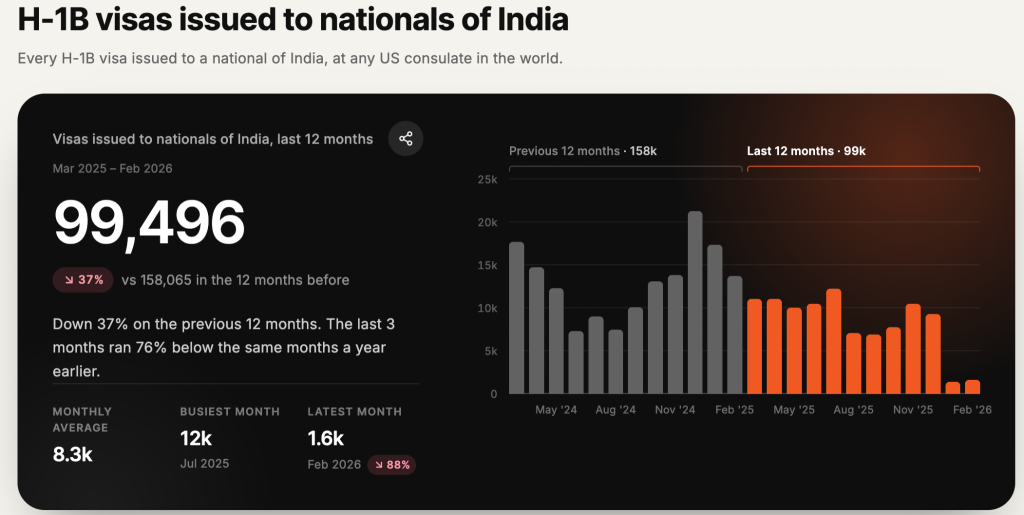
That represents a decline of approximately 90%.
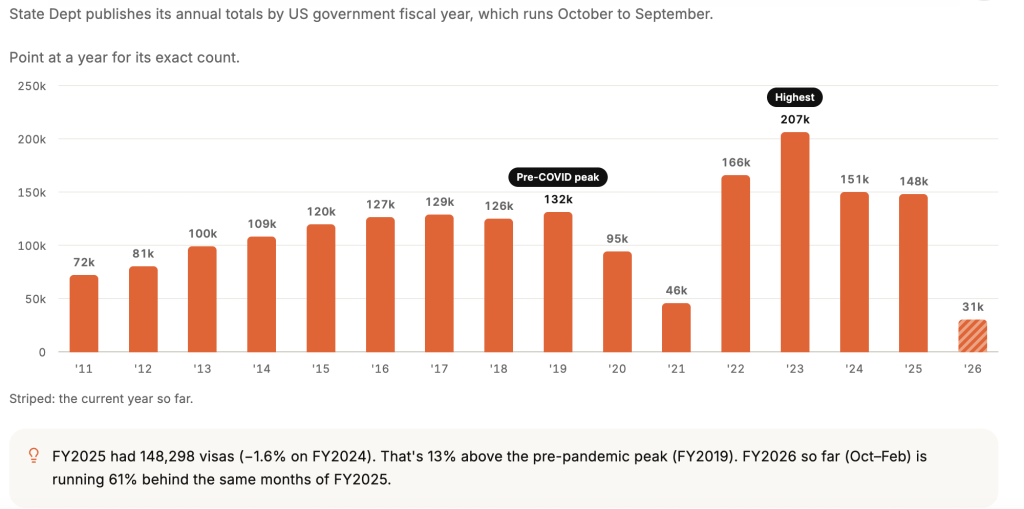
Source: www.checkvisaslots.com
These figures refer to visas issued at US consulates, not the number of H-1B petitions approved or existing workers leaving the country. The available 2026 monthly data should also not be mistaken for a full-year total.
The $100,000 question
Another major source of uncertainty is the Trump administration’s $100,000 H-1B payment requirement, announced in September 2025. The measure targeted certain new H-1B workers entering the US from overseas. It was not a blanket charge on existing visa holders or routine extensions.
The measure was struck down by a federal court in June 2026, and the administration’s appeal did not immediately restore its collection.
Separately, the Department of Homeland Security proposed a $103,265 fee for certain H-1B petitions in August 2026. This is a different measure and remains a proposal, not an implemented charge. For employers dependent on international recruitment, the prospect of significantly higher sponsorship costs adds another layer of uncertainty.
Immigration rules are changing the equation
The changes go beyond fees. The US introduced a weighted H-1B selection system in February 2026, giving greater weight to applications offering higher wages. The Department of Labor has also proposed changes to prevailing wage calculations and tighter requirements for the PERM green-card process.
These developments are changing how companies approach international hiring. Bloomberg also reported that IBM is ending visa sponsorship for most positions in its consulting division, while some companies are considering shifting hiring and development activities overseas.
The administration maintains that these measures are intended to protect American workers and prevent misuse of the H-1B programme. But for foreign professionals, the practical concern is whether they can build a stable future in the country.
Is the American Dream moving elsewhere?
The UK, Canada and UAE are increasingly featuring in the plans of Indian professionals reconsidering their American careers. Others are looking at returning to India, particularly technology hubs such as Hyderabad and Bengaluru.
This does not mean Indian professionals are abandoning America en masse. The US continues to attract global talent through its universities, research institutions and technology companies.
But the definition of an attractive career destination is changing. A high salary is no longer enough if workers cannot confidently plan their future, travel freely or secure permanent residency. For America, the challenge may no longer be just attracting the world’s best talent, but convincing them to stay.
Latest Articles






Tags H1B