 Gulte Movie News And Politics
The Indian-American population in the United States has crossed another demographic milestone. More than 5.4 million people now identify as Asian Indian alone, while the broader population, including those who identify as Indian alongside another racial identity, is close to 5.9 million. The number of US residents actually born in India has also reached approximately 3.4 million, according to the US Census Bureau’s 2025 American Community Survey (ACS), released on October 29, 2026.
These numbers offer an interesting picture of how the Indian diaspora is changing. Indians are now ahead of Chinese Americans when comparing people identifying with either group alone. However, when multiracial identities are included, the Chinese-origin population remains marginally larger. The figures also show how Indian communities are concentrated in a handful of American states and metropolitan areas.
How many Indians live in America?
The 2025 ACS estimates that approximately 5.41 million people identify as Asian Indian alone in the US, up from around 5.09 million in 2024. This represents an increase of approximately 315,000 people, or 6.2%, in a year. When people identifying as Indian alone or in combination with another racial identity are included, the population rises to approximately 5.91 million, compared with 5.56 million in 2024.
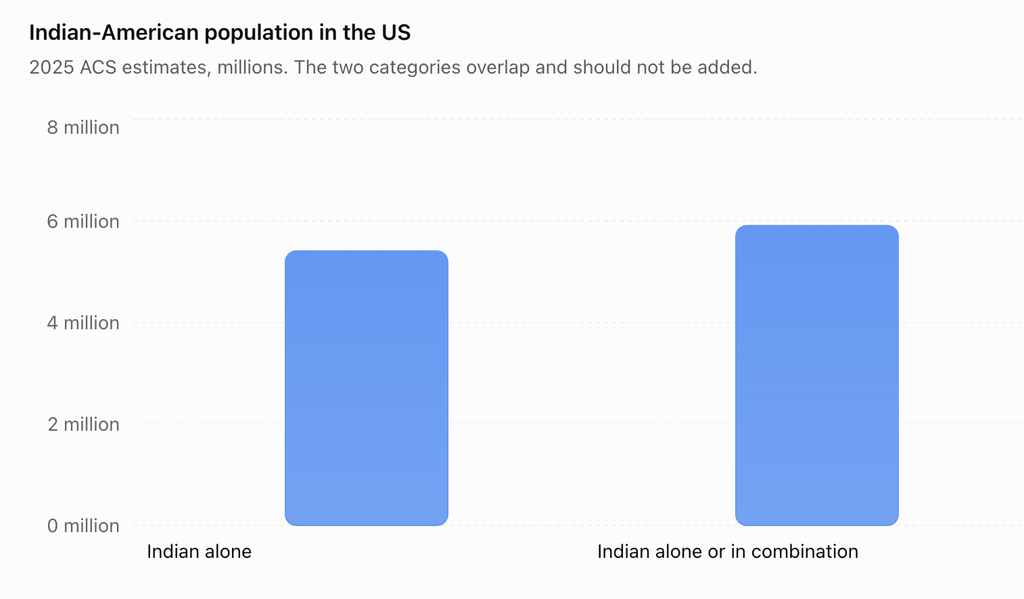
There is an important distinction between these numbers. The 5.41-million figure counts people identifying exclusively as Asian Indian, while the 5.91-million estimate also includes people reporting Indian identity alongside another racial identity. These are overlapping categories and should not be added together.
The number of residents born in India and living in the US stands at approximately 3.40 million, compared with 3.16 million in 2024. That is an increase of roughly 240,000, or 7.6%. Unlike the broader Indian-American population, this figure is based on country of birth. It includes naturalised American citizens, permanent residents and people on temporary visas, among others. It is not a count of Indian passport holders.
Indians versus Chinese Americans
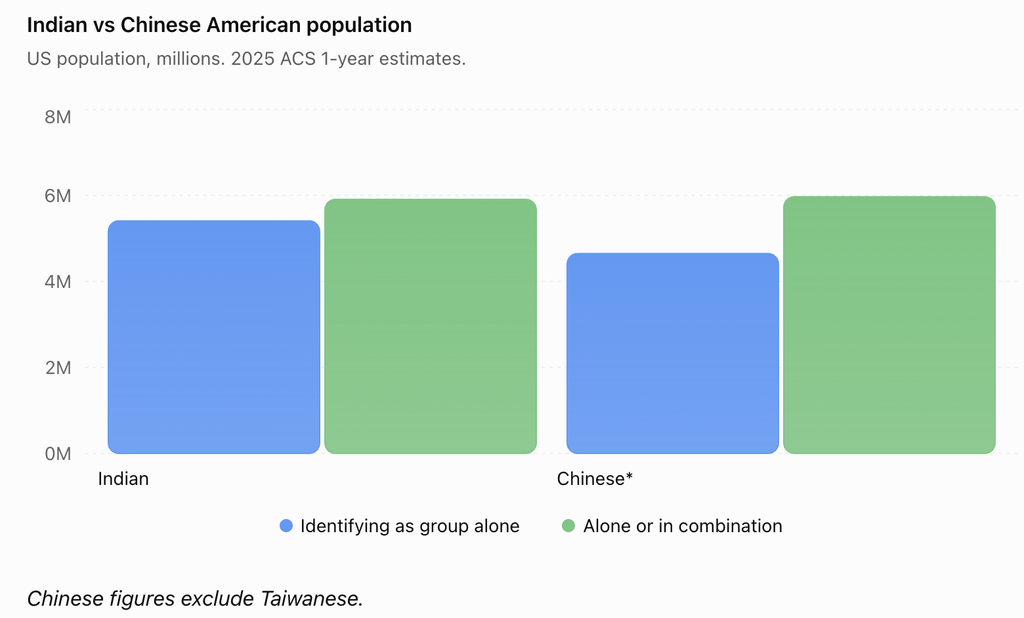
The comparison between Indian and Chinese Americans is particularly interesting. When people identifying with just one Asian-origin group are counted, Indians are ahead. The Indian-alone population stands at approximately 5.41 million, compared with around 4.65 million Chinese Americans, excluding Taiwanese. That gives Indians a lead of approximately 760,000.
However, the picture changes when people identifying with multiple racial identities are included. The Chinese population identifying as Chinese alone or in combination stands at approximately 5.97 million, marginally above the Indian figure of 5.91 million. The difference is just around 60,000.
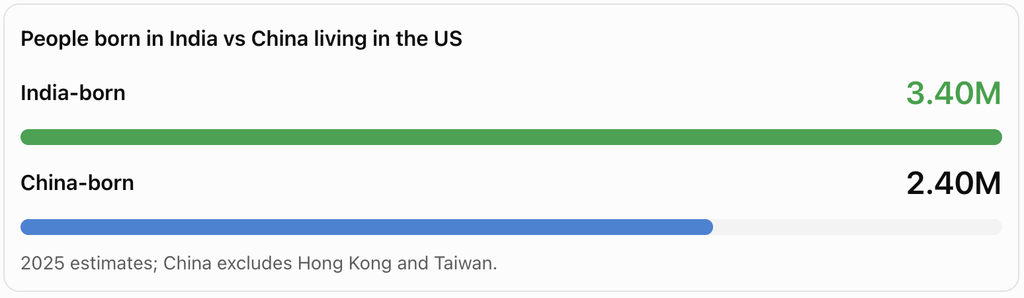
The comparison is different when looking at immigration. Approximately 3.40 million US residents were born in India, compared with 2.40 million born in China, excluding Hong Kong and Taiwan. India is therefore ahead by approximately one million people in this category. The distinction is important: the figures for Indian and Chinese Americans measure self-reported racial identity, while the immigrant figures measure country of birth.
Where do Indians live in America?
Indian Americans are concentrated in a relatively small number of states. California has the largest population, with approximately 1.02 million people identifying as Asian Indian alone. Texas follows with around 708,000, while New Jersey has approximately 471,000. New York and Illinois complete the top five, with around 420,000 and 288,000 respectively. Florida ranks sixth, with approximately 239,000.
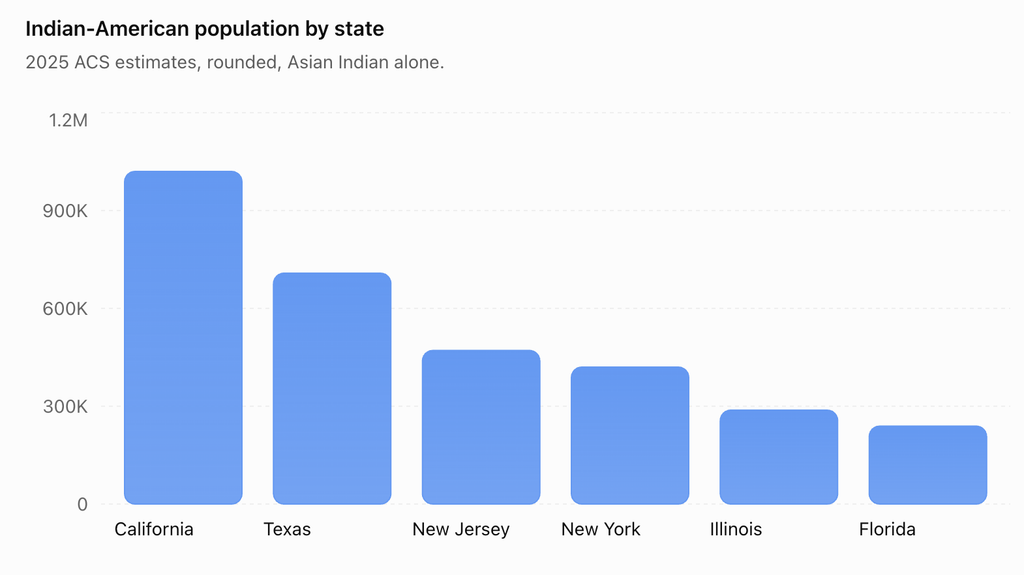
California and Texas together account for approximately 1.73 million Indian Americans. New Jersey’s position is particularly notable because of its relatively high concentration of Indian immigrants compared with its overall population.
The distribution of people actually born in India shows a similar concentration. According to the Migration Policy Institute’s analysis of pooled 2020–2024 ACS data, California accounts for 20% of India’s immigrant population in the US. Texas accounts for 12%, New Jersey 10%, Illinois 6% and New York 5%. These five states together are home to approximately 53% of all India-born immigrants in America.
Which American cities attract the most Indians?
Metropolitan areas provide a more useful picture than individual city boundaries, particularly because Indian communities often live in suburbs surrounding major employment centres. Greater New York, Dallas, San Francisco, Chicago and San Jose are among the largest metropolitan destinations for India-born immigrants.
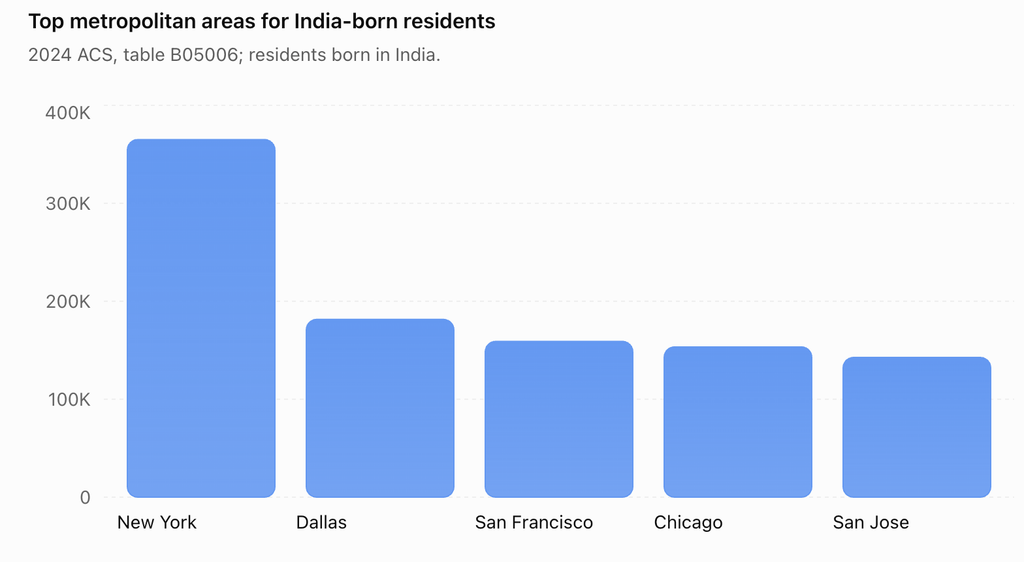
Together, these five metropolitan areas account for approximately 35% of India’s immigrant population in the US, according to the Migration Policy Institute’s analysis of 2020–2024 ACS data. The New York metropolitan region is the largest destination, followed by Dallas, San Francisco, Chicago and San Jose.
The Bay Area is particularly significant. San Francisco and San Jose together have a substantial India-born population, reflecting the region’s concentration of technology companies, research institutions and professional services. Dallas has also become an important destination, while the New York and New Jersey region continues to attract immigrants through established professional and community networks.
Why is the Indian population growing?
Skilled migration, higher education and employment opportunities are important parts of the story. The Migration Policy Institute estimates that the India-born immigrant population grew by 78% between 2010 and 2024, compared with 26% growth in the overall foreign-born population.
Education levels also help explain the profile of this community. According to MPI’s 2024 analysis, approximately 82% of Indian immigrants aged 25 and above had at least a bachelor’s degree. Indians also accounted for 71% of H-1B visas issued to highly skilled workers in fiscal year 2024. Meanwhile, more than 363,000 Indian students were enrolled in American higher education institutions during the 2024–25 academic year.
The Indian-American community is therefore no longer just an immigrant population. It includes generations of American-born Indians, naturalised citizens, recent arrivals and people from mixed backgrounds. Their experiences and relationships with India can be very different.
The latest Census estimates underline the scale of this transformation. With nearly six million people identifying as Indian, a 3.4-million India-born population and communities concentrated across America’s major economic centres, Indians have become one of the most prominent Asian-origin populations in the country.
Latest Articles






Tags Chinese Americans Indian Americans